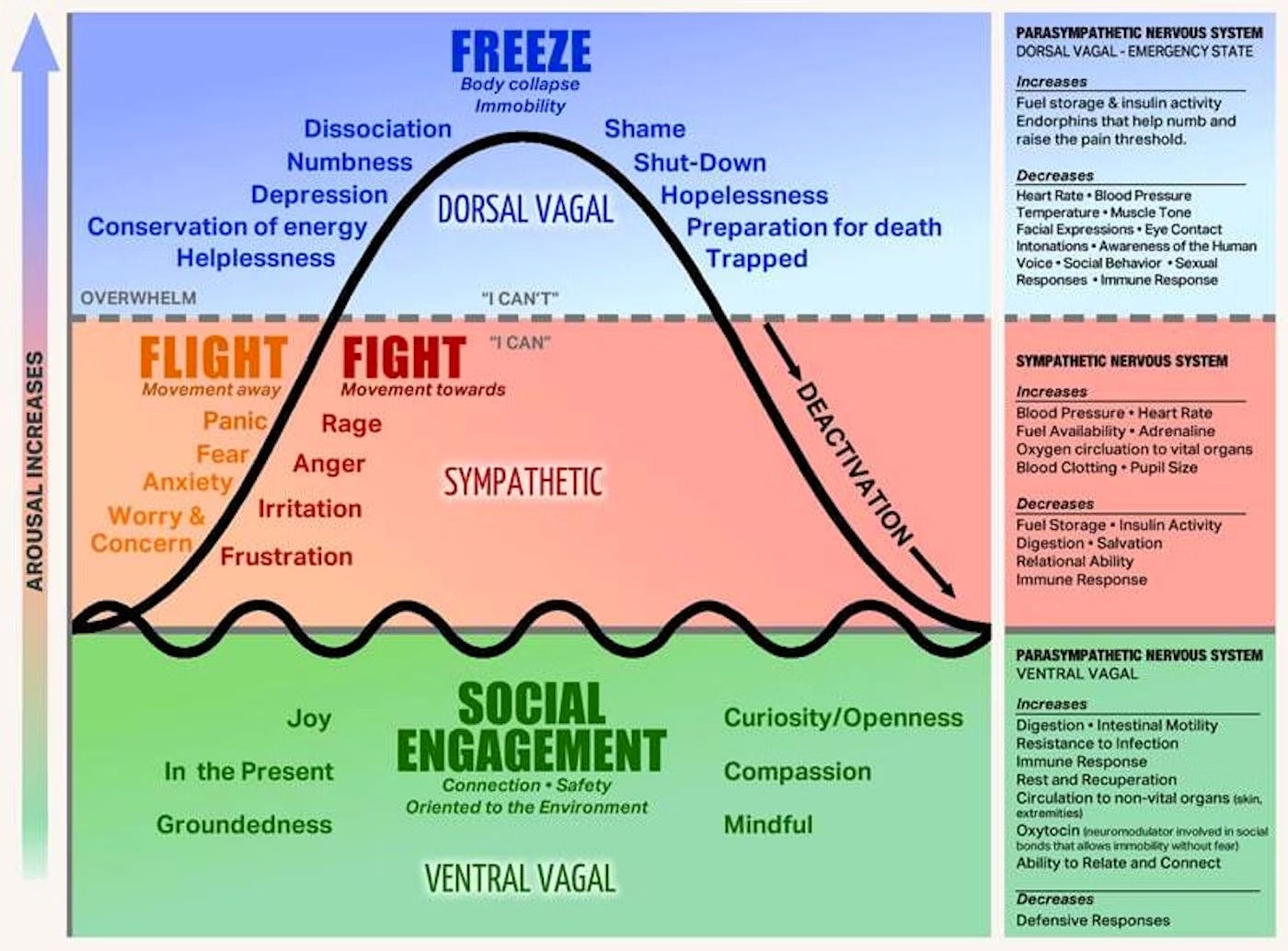
Polyvagal Theory
Understanding polyvagal theory is important in life as it provides insights into how our autonomic nervous system influences our responses to stress, social interactions, and overall well-being.

Polyvagal theory and our Wholeness Companions
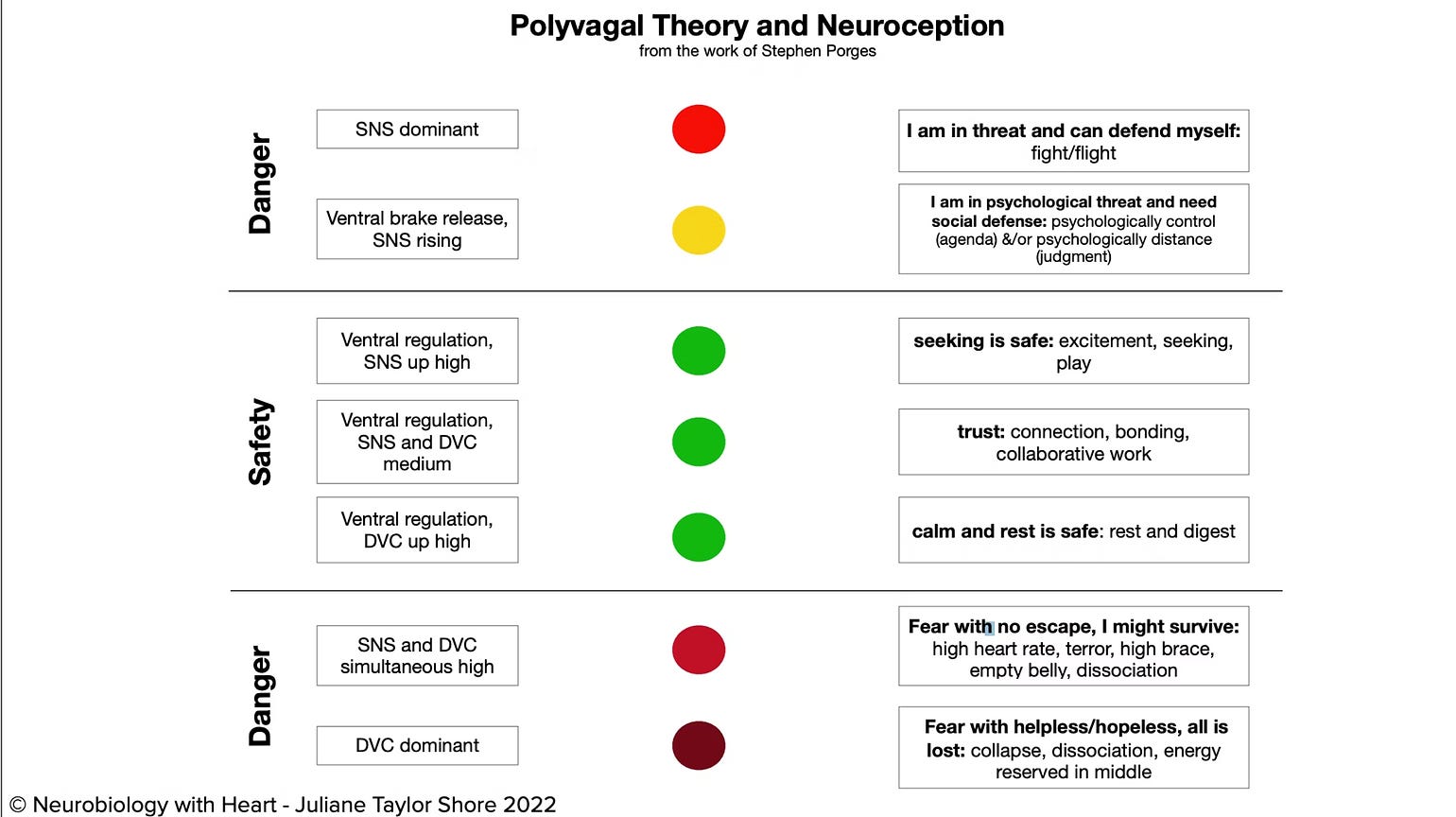
Our body’s subconscious intelligence (neuroception) scans our environment for safety or danger four times a second.
And, when it does, it will perceive one of the seven general states of safety or danger we see in the diagram below. This is where our WholenessCompanions are born.
In the top tier, our Brick Wall or Jellyfish Parents will do what they need to do to defend themselves. The particular Parent who emerges (rigid or yielding) depends on the many life factors which have formed them; we generally have a tendency towards one.
In the middle tier of safety, we find our Innocent Child playing, our Backbone Parent collaborating, and our Mystic meditating.
The last tier introduces us to our Escape Artist, full of a directionless energy, and finally our Zombie who is depleted of energy.
Once we understand these neurological states, we can feel empowered to create a shift. Using the exercises in Rewire For Resilience you can begin to change your wiring to better embody safe states of being. In our sessions of Allowing Wholeness, we call upon the wisdom of our Grandmother and our Old Friend, we listen to a potential Scared Child, and we create the conditions for your nervous system to perceive and experience safety in the world.
Polyvagal Theory 101
Seth Porges, son of Stephen Porges, who developed Polyvagal Theory, presents this important concept in a clear and accessible way in this video.
Trauma & the Nervous System
This 9 minute video was developed to give a basic introduction and overview of how trauma and chronic stress affects our nervous system and how those effects impact our health and well-being.
Much of the content is based on the groundbreaking work of Stephen Porges and his Polyvagal Theory and inspired and informed by the work of thought leaders Deb Dana, Vincent Felitti, Robert Anda, Gabor Mate, Dan Siegel and Peter Levine.
Please note that I am not a trauma specialist. As a coach, my focus is on the present moment and helping clients move forward into the future. However, it is important to acknowledge that many of the individuals I work with have had experiences of trauma.
Addiction: Wired for Connection
The opposite of addiction is connection. Our Escape Artist (Wholeness Companions) shows us that if we don’t have meaning, purpose and connection (right brain, ventral vagal nerve) in our life, then we will seek other activities that will soothe us (unbalanced sympathetic nervous system and dorsal vagal nerve).
Everything you think you know about addiction is wrong
What really causes addiction -- to everything from cocaine to smart-phones? And how can we overcome it? Johann Hari has seen our current methods fail firsthand, as he has watched loved ones struggle to manage their addictions. He started to wonder why we treat addicts the way we do -- and if there might be a better way. As he shares in this deeply personal talk, his questions took him around the world, and unearthed some surprising and hopeful ways of thinking about an age-old problem.
Here is an engaging, simple, and poignant explanation of this concept.
Organizing Principles of Polyvagal Theory
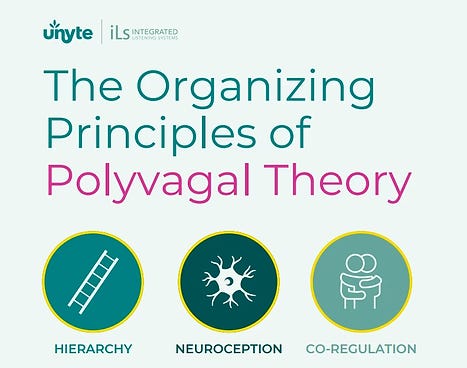
Dr. Stephen Porges’ Polyvagal Theory has revolutionized the way we view the body’s response to stress, considering the autonomic nervous system (ANS) the foundation of our lived experience. Originally, we viewed the body’s reaction to stress as binary: we’re either in a sympathetic or parasympathetic state. Polyvagal Theory, however, shows that there are multiple and blended states of arousal in response to real or perceived stress. In simpler terms, Polyvagal Theory helps us understand how we engage in and interact with the world.
Click on the pdf below to find an illuminating infographic on this subject.

Nerve Resiliency Spectrum
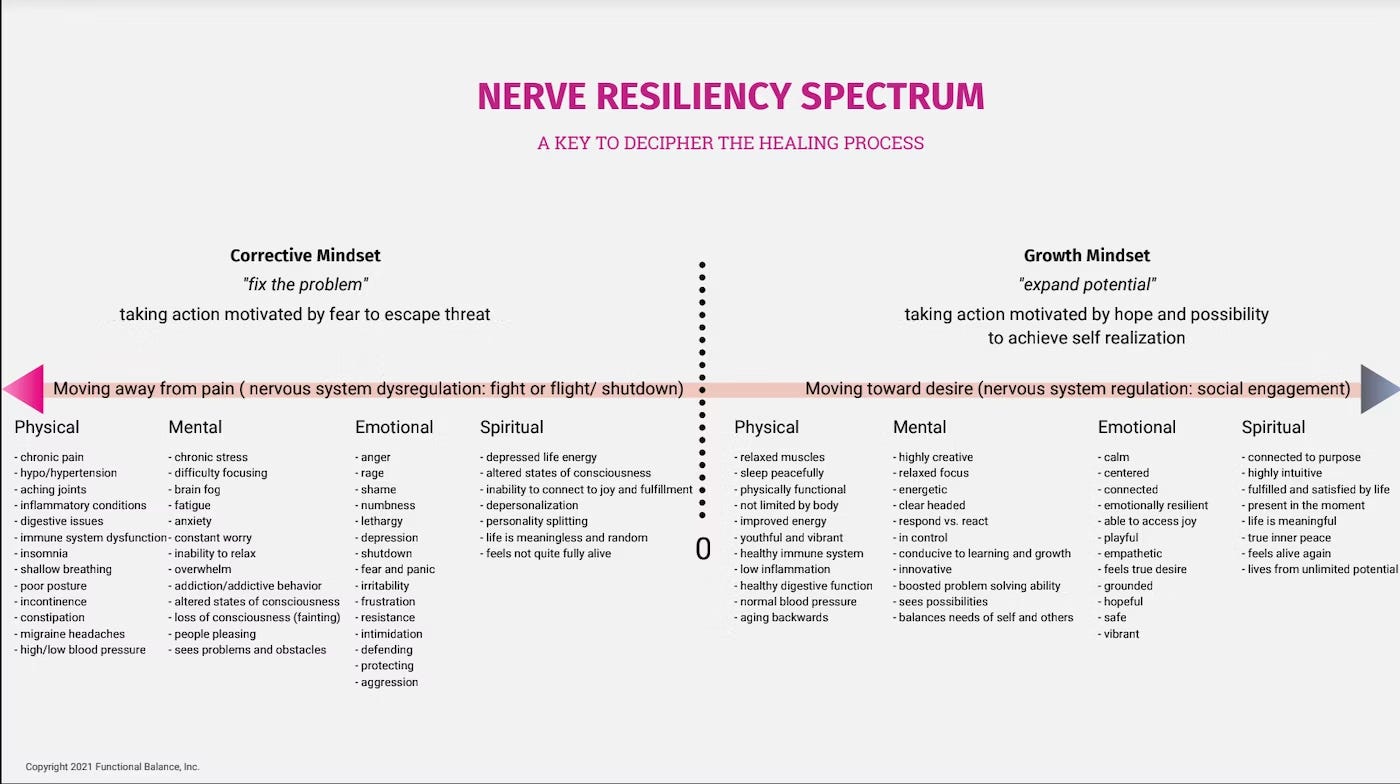
Resilience, in relation to the polyvagal theory, pertains to individuals’ capacity to effectively navigate and recover from challenging situations. The theory suggests that our autonomic nervous system responds to threats through a hierarchy of defense mechanisms, including immobilization, fight or flight, and social engagement. Resilience within this theory involves the ability to regulate these responses and swiftly return to a state of safety and social connection. By practicing techniques like mindfulness and grounding, individuals can cultivate resilience, enhancing their ability to adapt to stressors, regulate emotions, and maintain healthy relationships, thus promoting overall well-being.
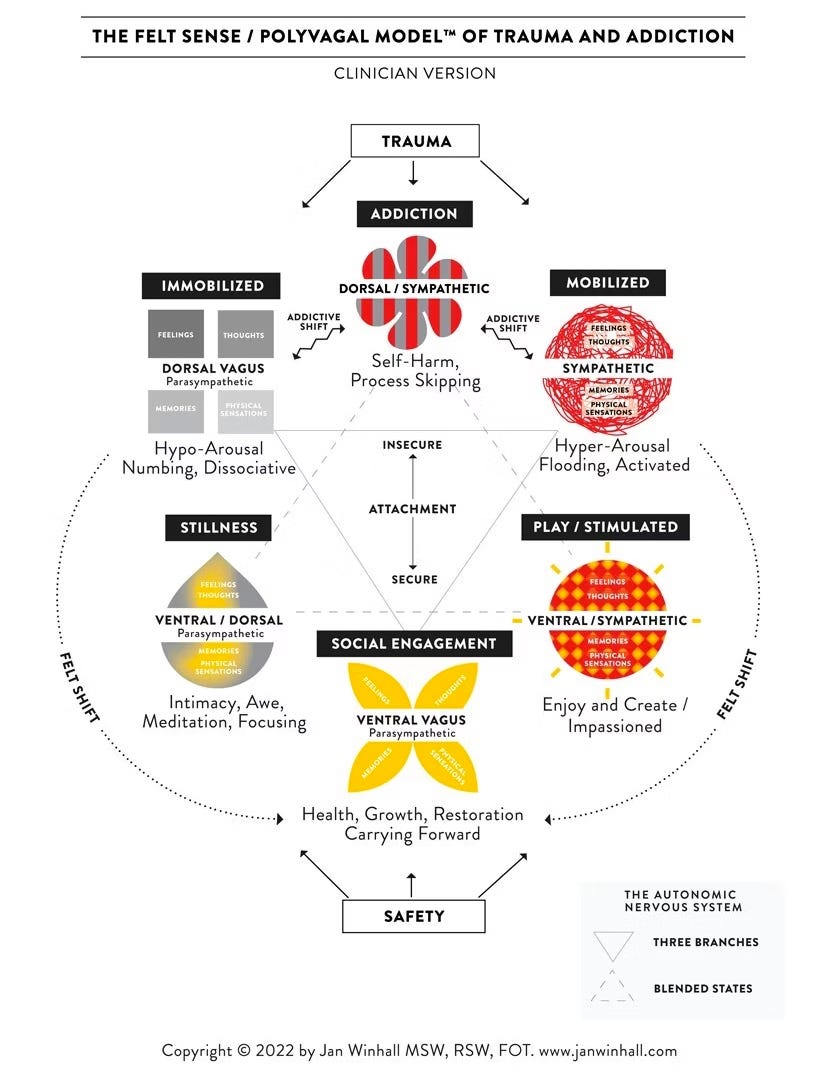
Polyvagal Model of Trauma & Addiction
By cultivating mindfulness and attunement to our felt sense and having knowledge of polyvagal theory, we can develop a greater capacity to listen to our body’s wisdom, access intuition, and engage in deeper self-exploration. It is a way of accessing and integrating the wisdom and intelligence that resides within our bodies, supporting our overall well-being.
The “felt sense” refers to a bodily sensation or intuitive knowing that arises in our awareness. It is a term commonly used in the field of somatic psychology and is associated with the work of Eugene Gendlin. The felt sense encompasses subtle physical sensations, emotions, and other bodily cues that provide us with a deeper understanding and meaning beyond what can be easily expressed in words.
It is often described as a holistic bodily experience that carries implicit knowledge or insight. It involves tuning into and becoming aware of the subtle nuances of our bodily sensations, emotions, and energetic states. The felt sense can offer valuable information about our inner experiences, helping us gain insight, make decisions, and navigate personal growth and healing processes.
NB: I am not a trauma and addiction specialist. However, I do have clients who come to me who experience these life events.
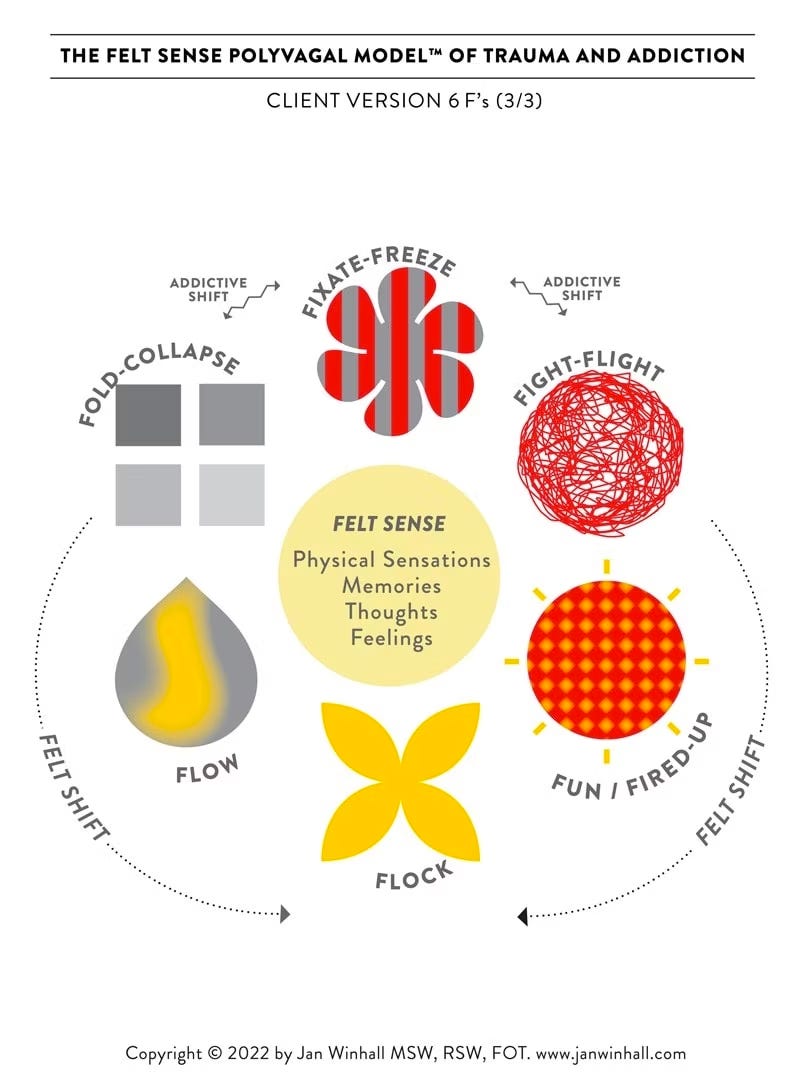
For those of you who seek a more detailed model:
Window of Tolerance
Befriending our nervous system allows us to sense when we have moved outside our window of tolerance.
What do you notice about your body sensations, emotions and behaviours when you become hyper-aroused or hypo-aroused?
Using the practices for calm in the Rewire for Resilience program will help to increase the size of the window. This is increased resilience.
The practices to energize, in the above program, will bring us out of hypo-arousal. It is important to do the right amount where we continue to feel safe and not over-aroused.
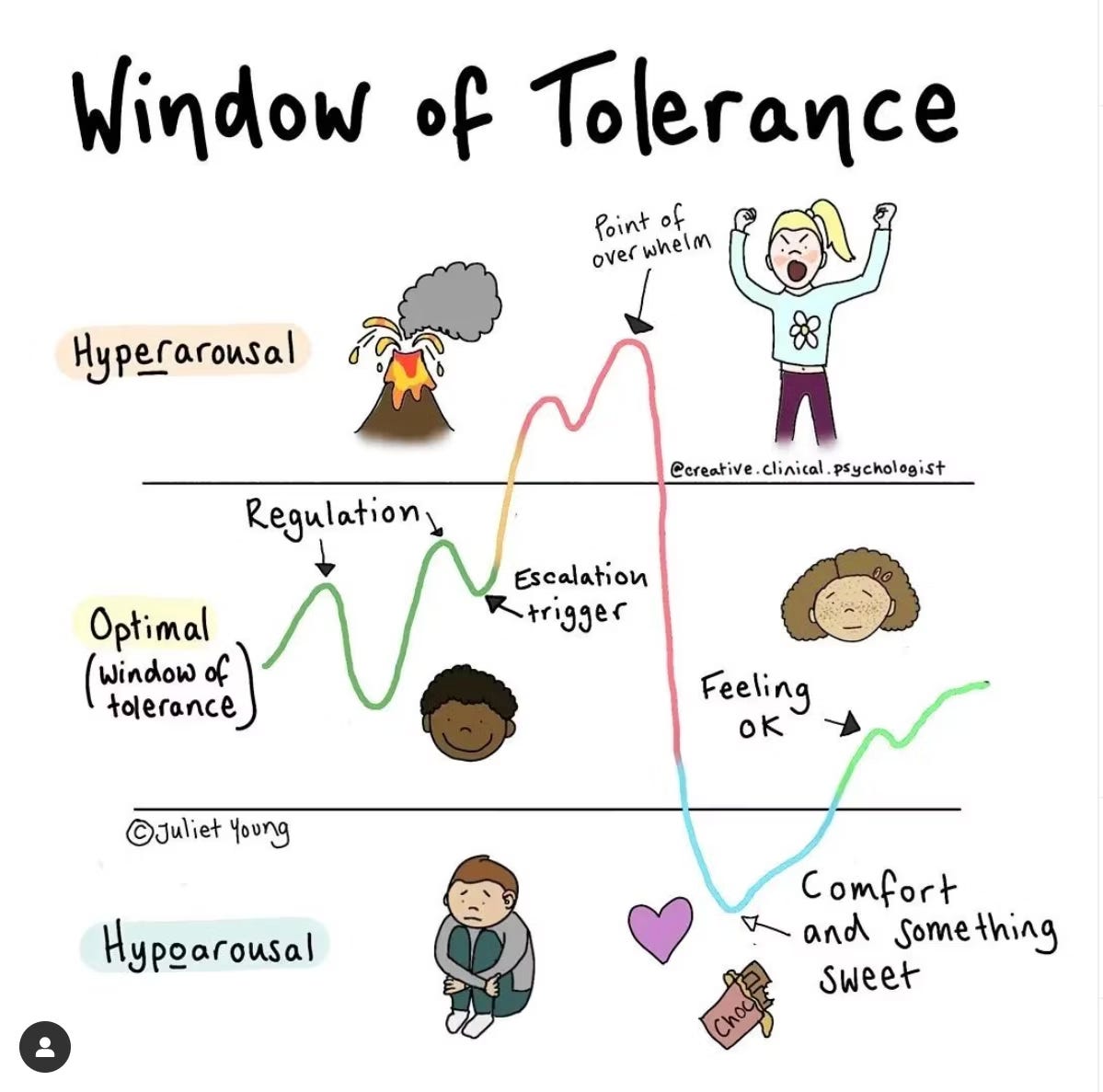
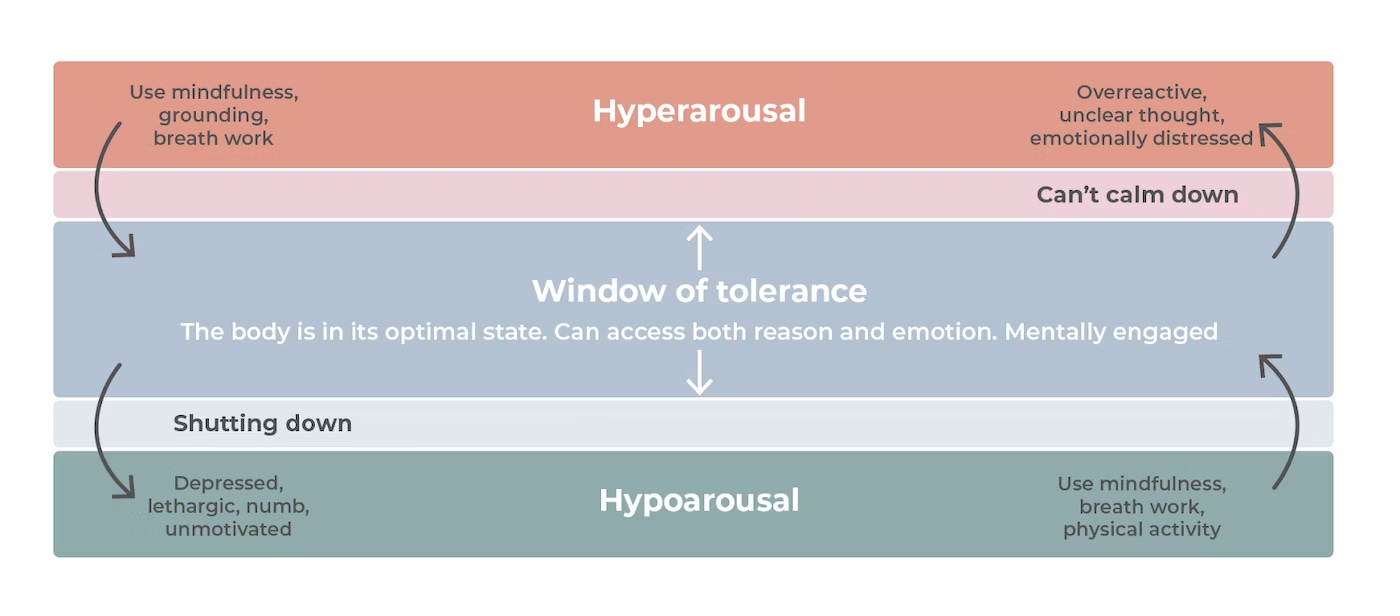
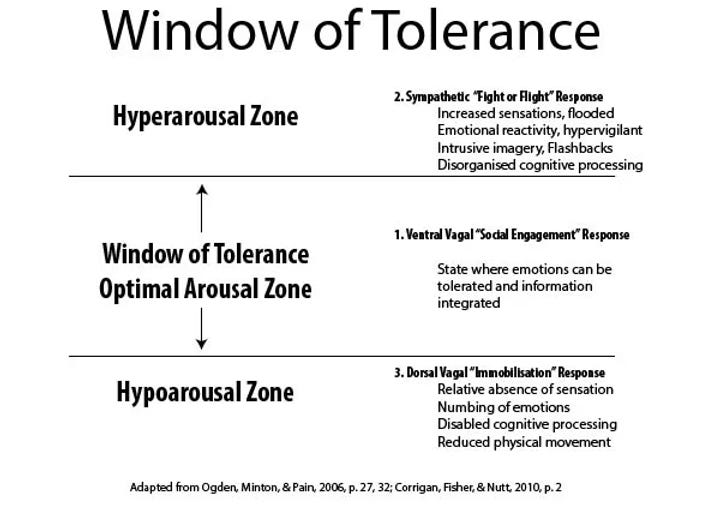
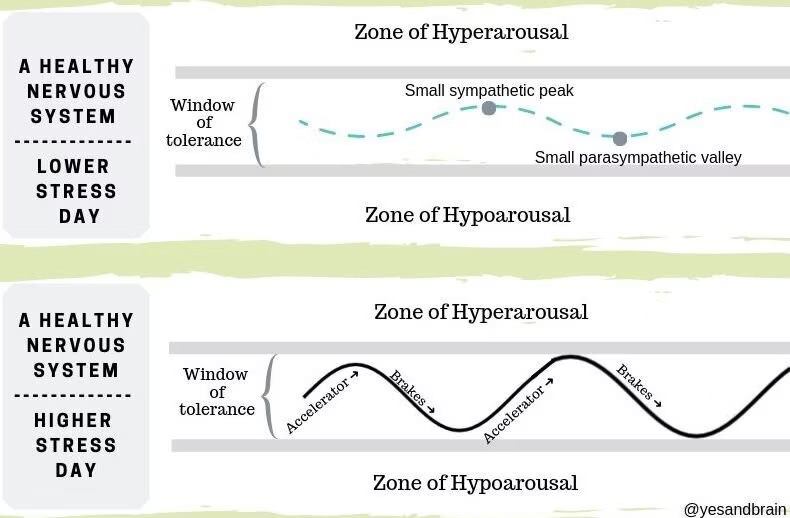
This 12 minute animation uses beautiful imagery to describe what we mean by our ‘Window of Tolerance’. Our Window of Tolerance is where we are at our personal best – where we can play, think, love and be loved. When we experience trauma and adversity – our Window of Tolerance narrows, and we become sensitive to stress. In this video, we explore what this looks like in children and adults, and we also explore how you can support those of us who carry trauma in our nervous system.
NB: I am not a trauma specialist. However, I do have clients who have this experience in their lives.
The Vagal Brake
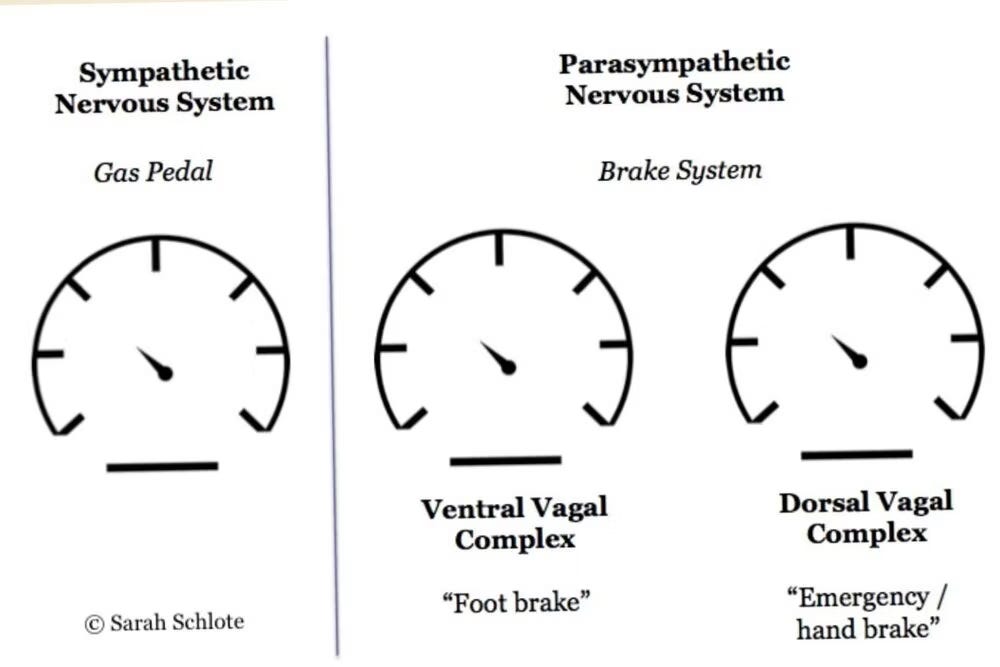
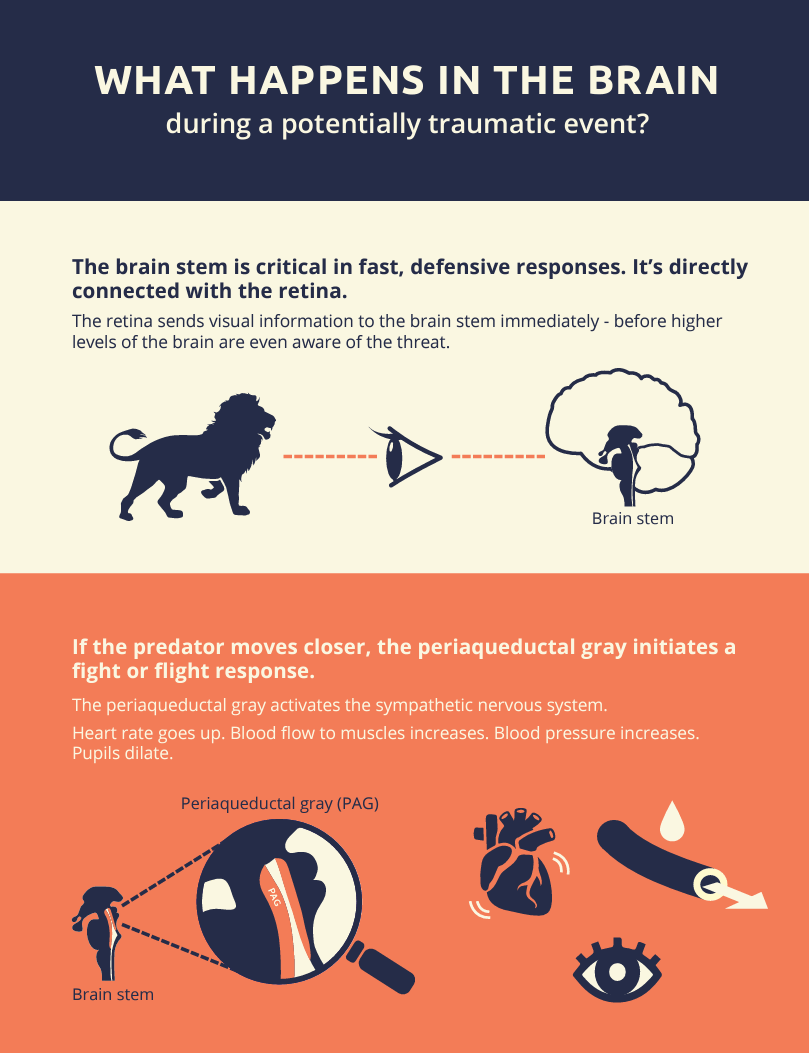
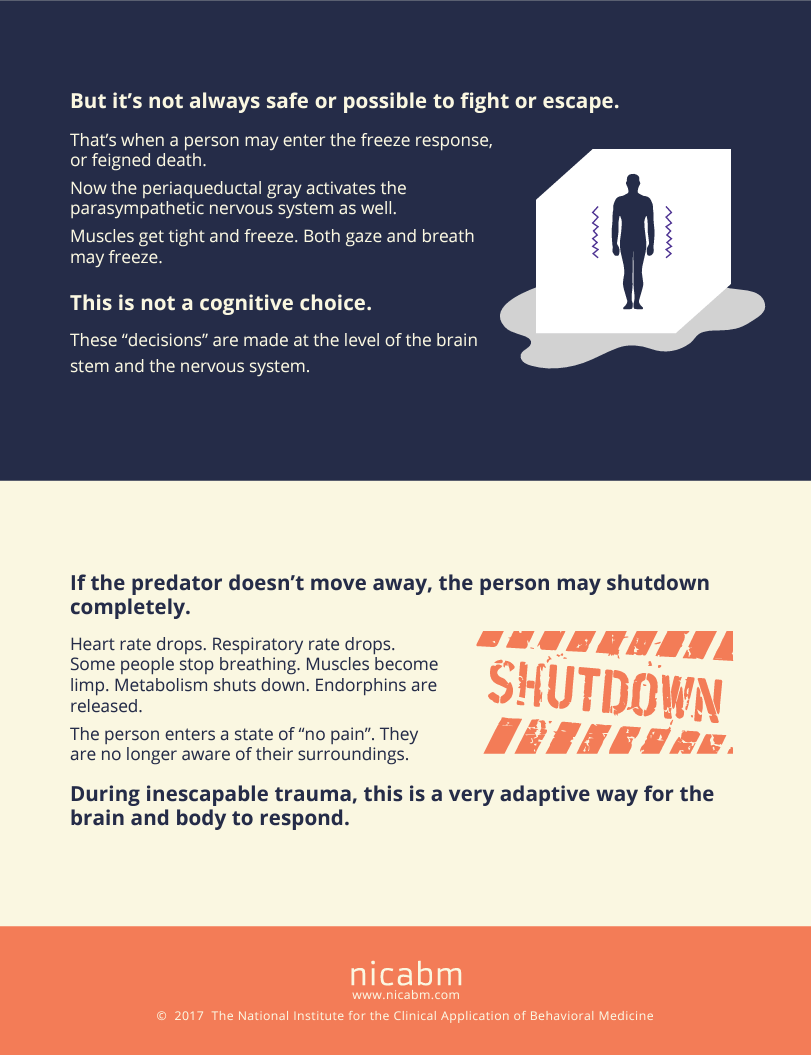
The vagal brake plays a crucial role in regulating our heart rate and responding to threats. When faced with a threat, the sympathetic nervous system activates, speeding up our heart to prepare for a fight or flight response. However, the vagal brake, specifically the dorsal vagal nerve, acts as an emergency brake, causing a sudden halt or freeze response. This response occurs when the threat is overwhelming, and our body perceives no viable options for fight or flight.
On the other hand, the ventral vagal nerve serves as a gentler and intentional mechanism that slows down our heart rate to find calm when the threat turns out to be a trigger from our Scared Child (Wholeness Companions Program). By engaging the ventral vagal response, we can create a sense of safety and security, promoting relaxation and a return to a balanced state.
To strengthen the vagal brake and enhance our resilience, tools from the Rewire to Resilience Program and practices like pendulation in the Embodiment Experience can be utilized. These approaches, employed by our Backbone Parent (Wholeness Companions), support the development of a wider window of tolerance, expanding our capacity to handle stressors and challenges. By cultivating a strong vagal brake, our nervous system becomes more resilient, enabling us to navigate adversity with greater ease and adaptability.
Neurological Response to Potential Threat
Autonomic Nervous System and Polyvagal Theory