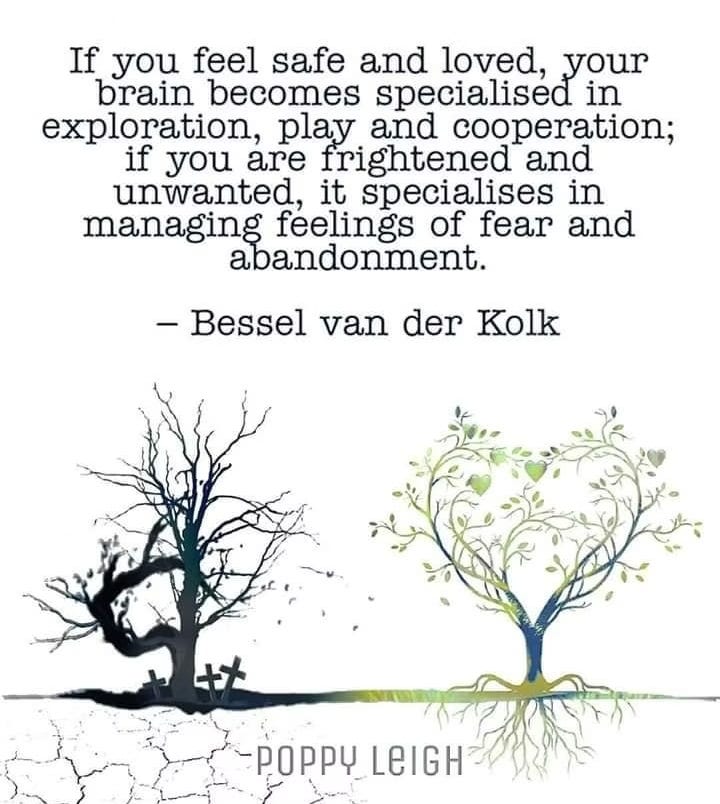
Our Scared Child’s Wiring (neural networks)
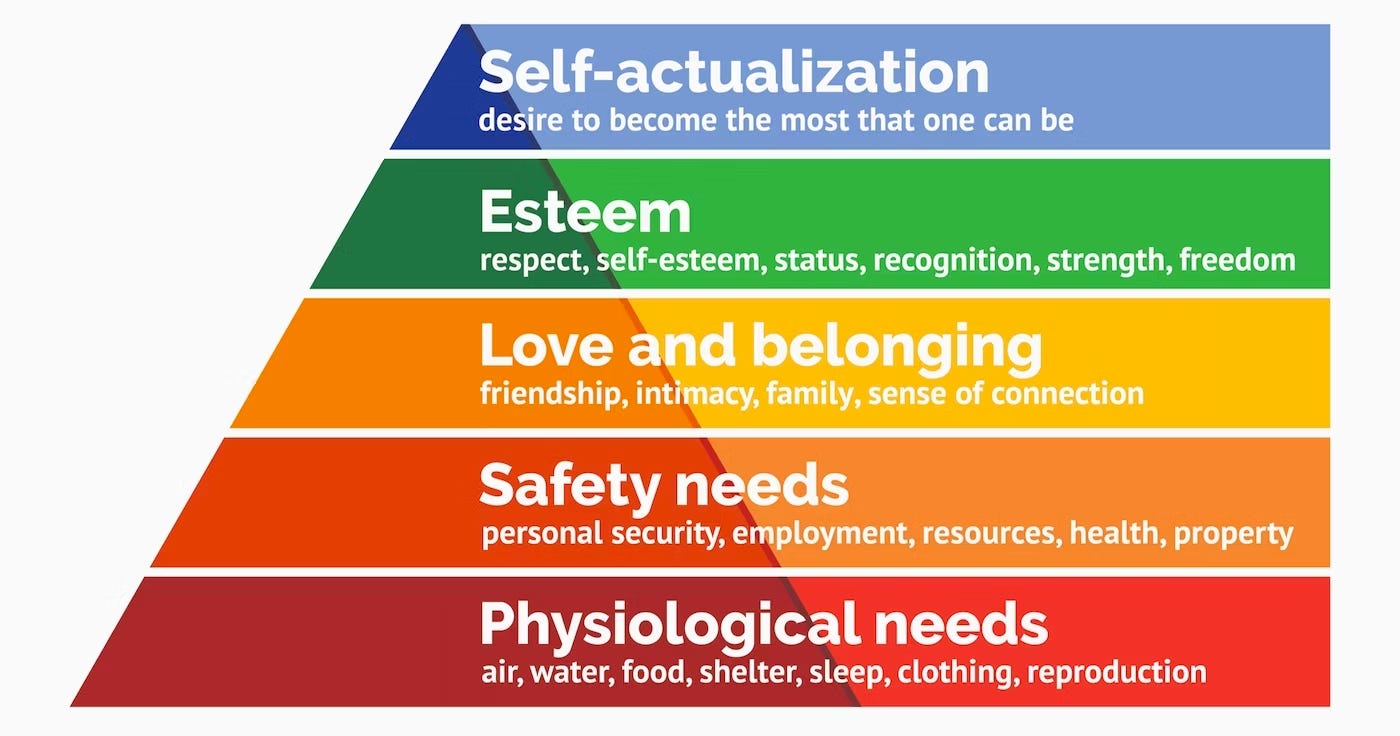
Neuroception—the constant, subconscious scanning for safety or danger—activates excitatory pathways in the left amygdala, part of the brain’s emotional subcortical system. This signals that the first three levels of needs in Maslow’s hierarchy of needs have not yet been sufficiently met.
As young children, we do not yet have inhibitory neurons from the prefrontal cortex to offer compassion, empowerment, and care to ourselves. So when our sympathetic nervous system is activated to mobilize, to act, and to get its needs met, our Scared Child neural network only has raw emotions and no means to move out into the world to change its environment.
As we grow older and our prefrontal cortex develops, we may channel the sympathetic energy of this flooded part by creating our Brick Wall (fight response) or Jellyfish Parent (fawn response). If the situation appears, or is, life-threatening, we may bypass the Parents altogether and our Zombie will step in to save us (freeze response). These are great coping method to control, appease and silence our Scared Child.
To rewire, our regulated, left prefrontal cortex (Backbone Parent) or that of a therapist, friend or coach, perceives enough stress to sense that change is valuable. At the same time, our right prefrontal cortex (Our Mystic), or mirrored by someone else, is able to offer enough compassion to feel safe. Our left amygdala (Scared Child) gains coherence with our prefrontal cortices through the space and presence of our cardiac brain (Our Grandmother). In turn, we contact our enteric/body brain (Our Old Friend) to feel/sense/embody what was too scary to experience on its own. When this happens, the neural network finds calm through the ventral vagal branch of the parasympathetic nervous system and reaches an integrated state. As a result, we feel connected to Self, others, the world, and Something Greater.
An Interview with Our Scared Child
What are your first memories?
My first memories are of feeling unsafe. There is a vague sense of my needs not being met. I did not feel loved, cared for, or nourished. There was a sense of danger, instability, and vigilance.
What do you know to be true about being a Scared Child, about life?
The world is unsafe and unpredictable.
I don’t matter.
I do not have value.
I am not seen or heard.
Vulnerability is scary.
I just need to survive.
I am unworthy.
Others undervalue me. They do not appreciate me. In the end, they really don’t want me around.
What does it feel like to be you?
Fear and worry are my most loudest emotions. They drive me.
Guilt and shame are a strong second because of what I know to be true about myself.
I feel uncomfortable in my own skin.
I feel oddly better when others feel bad.
I feel that there is never enough. I feel insatiable. This makes me feel jealous of others who have what I do not have. There is an ever-present lingering feeling of discontent.
I feel abused and/or insecure when someone offers constructive criticism.
I feel only conditional love, both received and given.
I feel overwhelmed and then I cannot handle more than one thing at a time.
I am hyper-vigilant and unsettled. I especially cannot relax amid the unknown, when things are uncertain.
I do not feel nuances of my emotions. They are pretty basic.
I feel lonely, but being around others gives me anxiety, frustration, and sometimes even panic.
Grief and sorrow well up for no reason.
I feel held back or stuck. Life seems to be working for everyone else.
In the end, I really loathe myself.
When you have those emotional knowing, how do you act in the world?
I often speak the quickest and loudest when something feels off, wrong, or unjust.
I compare everything to the past and make projections about the future.
I easily get caught up in the doom and gloom of the world. I often watch the news. My favourite entertainment genres are drama, action, horror, and psychological thrillers.
I use social media a lot and, even though it makes me feel really bad, I do not want to put it down.
I have a strong negative bias. Ok, I am a pessimist. I am critical of others and of the way the world works.
I will watch others play because that is much safer than actually participating.
I don’t want people to notice how I look. I actually don’t even care how I look.
I whine a lot so I can get people to tend to me.
I blame others. I am unable to take responsibility for my actions and feelings.
There is a pressure cooker which blows up inside of me that I cannot contain.
I doubt others and am suspicious of them. They say that I am secretive and guarded. I self-isolate because it is safer.
I say no quickly.
Others say that I am immature because I can throw a fit and call others names.
I take things personally. Everything is about me and others should see that. I provoke people so that they see and hear me.
I easily get angry, agitated and impatient because, well, look around you!
What do you sense in your body when all this is going on?
What are you talking about??? I ‘sense’ that people/the world should get their act together. I ‘sense’ that I am not ok. My body? Really????? I want to be anywhere else than inside my body.
What do you need?
I need compassion and companionship.
I need to be seen and heard.
I need to feel safe and cared for.
Complete this sentence: “ I.... “
I hurt.
Your Embodied Scared Child
Reflections
What is your experience of the Scared Child?
What thoughts and beliefs do they hold for you?
What emotions do you experience when this companion is running the show?
How do you hold your body or change your voice when this partner pays a visit?
How do you interact with the world when you embody this partner?
If your Scared Child had a name, what would it be?

Our Scared Child’s Playlist
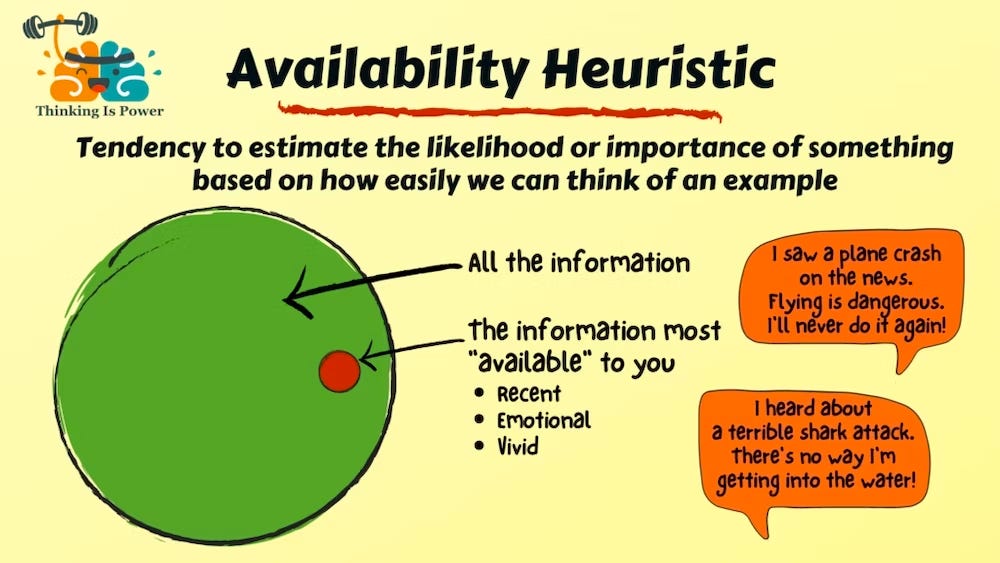
Availability Heuristic
The availability heuristic, when applied to an individual with adverse childhood events, refers to a cognitive bias that heavily relies on easily accessible memories and experiences from their past. Due to the traumatic nature of their childhood, these individuals may frequently recall and prioritize memories that reflect their negative experiences, often resulting in an overestimation of the prevalence and probability of similar negative events in their current and future circumstances. Their upbringing shapes their perception of the world, leading to a heightened sensitivity to potential threats, which can impact decision-making (see Backbone Parent) and overall well-being.
Being Judgemental
Innocent Child is the former and Scared Child is the latter.
Being Scared
Innocent Child is the former and Scared Child is the latter.